
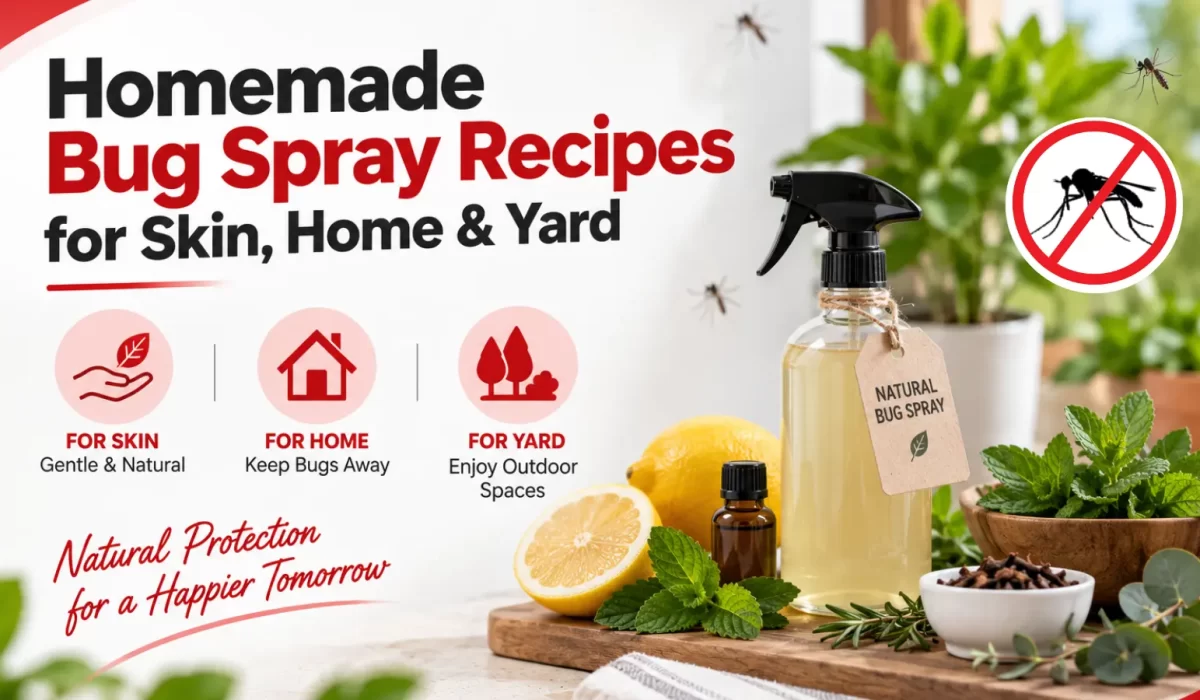
Bugs are a common nuisance, especially during warm and humid weather. Mosquitoes, flies, ants, and other insects can quickly turn a comfortable evening outdoors into an irritating experience.
While there are many commercial insect repellents available, some people prefer simple homemade bug spray recipes made with familiar ingredients.
Natural ingredients such as citronella, peppermint, lavender, garlic and certain essential oils may help keep insects away. However, homemade sprays should be used with care. Their effectiveness can vary, and some essential oils can irritate the skin or damage plants when used incorrectly.
The good news is that you can make simple DIY bug sprays for different areas of your home. From a skin-friendly spray to an outdoor solution for your garden, these recipes can be useful as part of a wider insect-control routine.
What Natural Ingredients Help Repel Bugs?
Several plant-based oils are commonly used in natural insect repellents. Their strong scents may make an area less attractive to mosquitoes and other insects.
Citronella is one of the best-known natural mosquito repellents. Peppermint, lavender, garlic, thyme and some citrus oils are also used in homemade bug spray recipes.
Research suggests that some of these oils can repel certain insects, although more research is needed to understand how well homemade mixtures work in real-world conditions.
It is also worth remembering that an ingredient can be useful around the home without being suitable for direct application to your skin. Always check the intended use of an essential oil before adding it to a DIY spray.
Citrus Oils
Citronella and citrus-based oils are popular choices for keeping insects away. Citronella, in particular, is widely used in outdoor candles and insect-repelling products. Its strong aroma may help discourage mosquitoes and several other insects from staying nearby.
However, citrus oils can sometimes make skin more sensitive to sunlight. For this reason, they should not be applied directly to the skin without understanding the safety precautions involved.
Garlic Oil
Garlic has a strong smell that insects tend to dislike. Garlic oil has been studied for its ability to repel certain insects, including ticks, and it can be used as an ingredient in some outdoor insect-control solutions.
A diluted garlic-based spray may be useful around gardens and outdoor areas. It is best to test any homemade mixture on a small area first, particularly when using it around plants.
Thyme Essential Oil
Thyme essential oil is another option sometimes used in natural mosquito and insect repellents. Some research suggests it may help repel mosquitoes, ticks and fleas.
Thyme essential oil should be diluted before it is used on skin. Essential oils are highly concentrated, so applying them directly may be irritating.
Oil of Lemon Eucalyptus
Oil of lemon eucalyptus is commonly used in insect-repellent products and has been studied for mosquito protection. It should not be confused with lemon eucalyptus essential oil, which is a different product and does not offer the same level of evidence for mosquito protection.
For reliable protection, follow the instructions on a properly formulated repellent rather than assuming that a homemade mixture will provide the same results.
Lavender and Peppermint Oil
Lavender and peppermint oils are popular ingredients in natural bug sprays because of their strong fragrances. Some research suggests lavender may help repel mosquitoes, while peppermint may help discourage mosquitoes, ants, flies and other insects.
These oils can be useful additions to home and outdoor sprays, but they should still be handled carefully. A natural ingredient can irritate if it is too concentrated.
Safety Tips Before Making Homemade Bug Spray
Before making any DIY insect repellent, take a few basic precautions. Essential oils are concentrated substances, and not every oil is suitable for use on the body.
If you are making a homemade bug spray for skin, use ingredients that are considered suitable for topical application and dilute essential oils properly. A carrier such as witch hazel or a suitable carrier oil can help reduce the concentration.
Be particularly careful with citrus oils. Some can cause photosensitivity, meaning that sunlight may increase the risk of skin irritation or burns.
It is also sensible to perform a small patch test before applying a new mixture over a larger area. Avoid spraying homemade repellents near the eyes, mouth or broken skin.
For children, pregnant people, pets or anyone with sensitive skin, extra caution is advisable. When strong or long-lasting protection is needed, a tested commercial insect repellent may be a better choice.
Homemade Bug Spray Recipe for Your Skin
A simple DIY skin spray can be made with a suitable essential oil and witch hazel. Healthline’s recipe uses either oil of lemon eucalyptus or lavender essential oil combined with witch hazel.
What You Need?
Use a clean glass spray bottle, witch hazel and a suitable essential oil. Lavender is one option, while oil of lemon eucalyptus is another. Make sure you are using the correct type of eucalyptus product and follow appropriate safety guidance.
How to Make It?
Mix one part of the chosen essential oil with ten parts witch hazel in the spray bottle. For example, one drop of essential oil can be combined with ten drops of witch hazel. Shake the bottle gently before use.
Apply a small amount to exposed skin and avoid the face and sensitive areas. If you notice redness, itching or discomfort, wash the area and stop using the mixture.
Remember that homemade bug spray should be treated as an additional protection measure rather than a guaranteed barrier against mosquito bites.
Homemade Bug Spray Recipe for Your Home or Yard
Your home and garden require a different approach from your skin. A spray intended for surfaces or outdoor areas does not need to be formulated in the same way as a skin repellent.
A simple homemade mixture can combine lavender essential oil, oil of lemon eucalyptus and citronella essential oil with distilled water and white vinegar.
What You Need?
You will need a glass spray bottle, distilled water, white vinegar, lavender essential oil, oil of lemon eucalyptus and citronella essential oil.
How to Make It?
Add 10 to 20 drops of each essential oil to around 2 ounces of distilled water and 2 ounces of white vinegar. Shake the bottle gently before spraying.
Use the mixture around suitable outdoor areas where insects gather. Avoid spraying it on surfaces that could be damaged by vinegar or essential oils. It is also wise to test a small, hidden area before treating a larger surface.
For indoor use, ensure the room is well ventilated and avoid spraying the mixture near food, children’s items or pets unless the ingredients are known to be safe for those surroundings.
Homemade Bug Spray Recipe for Plants
Gardens can attract mosquitoes and other unwanted insects, but spraying strong mixtures directly on plants can sometimes cause damage.
A diluted mixture containing a few drops of thyme essential oil, garlic oil or oil of lemon eucalyptus with distilled water may be used as a plant spray.
Test Before Spraying
Always test a homemade plant spray on a small section of one plant first. Wait and check how the leaves respond before treating the entire plant.
This is especially important with vinegar and strong essential oils. Some ingredients that repel insects can also harm plants when they are too concentrated.
Other Ways to Prevent Bug Bites
Homemade bug spray works best when combined with other simple mosquito prevention habits. Do not rely on a spray alone, especially in areas where mosquitoes are common.
Wear loose, light-coloured clothing that covers your arms and legs when spending time outdoors. Mosquitoes are often more active around dawn and dusk, so limiting outdoor exposure during these periods can also help.
Most importantly, remove standing water around your property. Check flower pots, plant trays, buckets, gutters, birdbaths and other containers where water can collect. Even small amounts of stagnant water can provide mosquitoes with a place to breed.
For an additional physical barrier, mosquito nets can help keep mosquitoes away from indoor living spaces. Properly fitted window and door screens are another practical option, particularly when you want fresh air without leaving an easy entry point for insects.
Keeping doors and windows screened, reducing stagnant water and using repellents together creates a stronger defence than relying on any one method.
Is Vinegar and Water a Good Bug Repellent?
Vinegar is often suggested as a natural insect repellent, but evidence for its effectiveness is limited. Some research has looked at apple cider vinegar and insect behaviour, but more research is needed before it can be considered a reliable bug repellent.
If you use vinegar in a homemade spray, think of it as one ingredient in a broader insect-control routine rather than a guaranteed solution.
What Is the Most Effective Natural Bug Repellent?
There is no single natural ingredient that works best for every insect or situation. Lemon eucalyptus, peppermint, garlic, dill, citronella and other plant-based oils have shown some insect-repelling potential, but their effectiveness can vary.
For this reason, the best approach is often a combination of methods. Use an appropriate insect repellent, cover exposed skin, remove standing water and install physical barriers such as mosquito nets and screens.
A Smarter Approach to Homemade Bug Sprays
Homemade bug sprays can be convenient when you want to try simple, plant-based ingredients around your home. Ingredients such as citronella, lavender, peppermint and garlic may help discourage insects, but they should be used thoughtfully.
Most importantly, natural remedies should not replace basic mosquito prevention. Remove standing water, keep doors and windows protected, cover exposed skin and use mosquito nets or screens where appropriate.
With the right combination of homemade solutions and physical barriers, you can make your home and outdoor spaces less inviting to mosquitoes and other unwanted insects.

Sivashankar Maruthachalam
Sivashankar Maruthachalam is the Founder of RK Ecran Private Limited, a Coimbatore-based manufacturer of premium mosquito net doors and windows. Since establishing the company in 2006, he has led RK Ecran from a pioneering startup to a market leader across southern India - with operations spanning Tamil Nadu, Kerala, and Karnataka.. Under his vision and leadership, RK Ecran introduced magnetic swing mosquito doors to the Indian market at a time when cumbersome Velcro-based nets were the only available alternative - a move that redefined the category. Today, the brand has served over 1,00,000 Indian homes, operates a 30,000 sq. ft. state-of-the-art manufacturing facility, and employs a team of 110 - making RK Ecran the first mosquito net brand in India to receive CE Certification from the European Union. Sivashankar's commitment to consistent quality, research-driven innovation, and customer satisfaction has shaped every aspect of the company — from its ISO-compliant manufacturing processes to its growing dealer network across the country.
