
Mosquitoes are small insects, but their life cycle is surprisingly quick. Understanding the mosquito life cycle can help explain why mosquito numbers can increase rapidly, especially during warm and wet weather. It also shows why even a small amount of standing water around a home can become a breeding site.
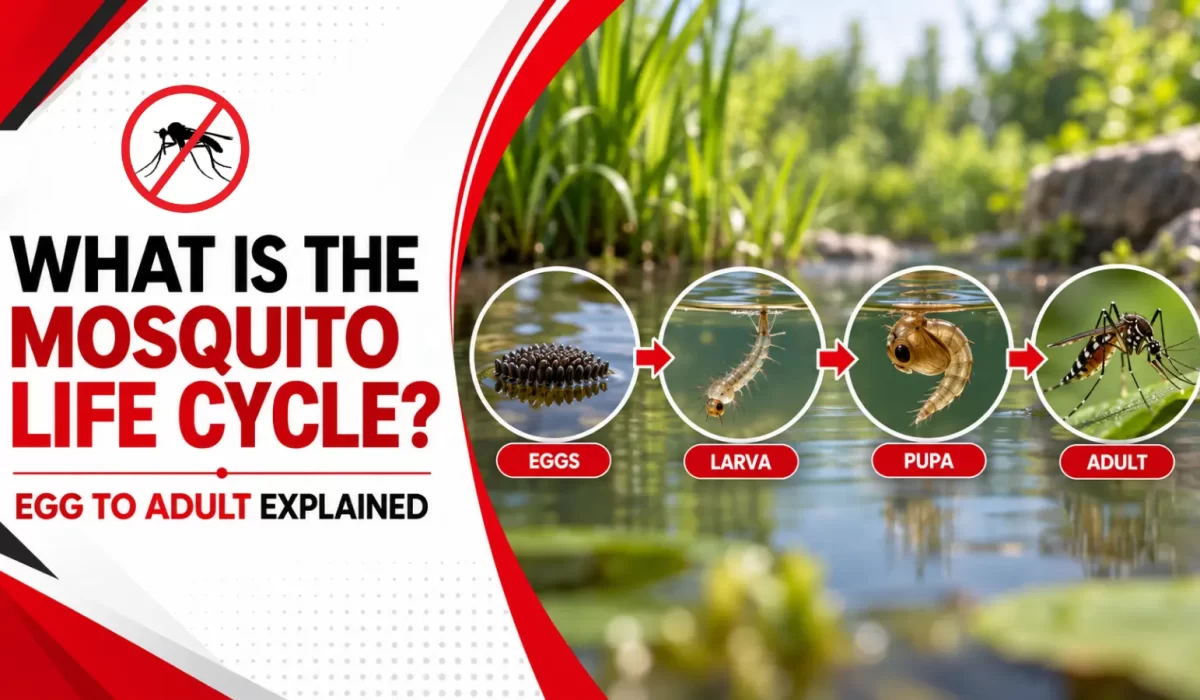
A mosquito passes through four main stages: egg, larva, pupa and adult. The first three stages take place in or around water, while the adult mosquito lives on land and in the air.
Depending on the species, temperature, food supply and other conditions, the complete journey from egg to adult can take as little as one to two weeks.
Each stage has a different appearance and purpose. Let us look at the mosquito life cycle in detail and understand how mosquitoes develop from tiny eggs into flying adults.
The Four Stages of the Mosquito Life Cycle
The mosquito life cycle is a process of complete metamorphosis. This means the insect changes form at each stage rather than simply growing larger.
The four stages are:
- Egg
- Larva
- Pupa
- Adult
Water plays a key role in the early stages. Mosquitoes often choose places where water collects and remains undisturbed. This can include ponds, drains, buckets, plant trays, discarded containers and other areas that hold stagnant water.
Once the adult mosquito emerges, it leaves the water and begins the next part of its life. Female mosquitoes may then mate, feed and eventually lay another batch of eggs, starting the cycle again.
Egg Stage
The mosquito life cycle begins when a female mosquito lays eggs. The location and arrangement of the eggs can vary between species. Some mosquitoes lay their eggs directly on the surface of water, while others place them on damp surfaces close to water.
A female mosquito can lay many eggs during her lifetime. Some species lay individual eggs, while others lay groups that can float together as a small raft. The eggs are often tiny and may be difficult to notice without looking closely.
Where Do Mosquitoes Lay Their Eggs?
Mosquitoes prefer areas where water is available for their young to develop. Common breeding spots include buckets, flower pots, old tyres, gutters, open containers and puddles. Even a small amount of stagnant water can sometimes provide enough space for eggs to develop.
How Long Do Mosquito Eggs Take to Hatch?
The time taken for mosquito eggs to hatch depends on the species and environmental conditions. When the eggs are exposed to suitable moisture and temperature, they can hatch into larvae within a few days. Warm conditions can speed up development, which is one reason mosquito populations may rise quickly during suitable weather.
Larva Stage
After hatching, the mosquito enters the larval stage, often called the “wriggler” stage. Mosquito larvae live in water and are easy to distinguish from adult mosquitoes because they do not have wings.
They usually remain close to the water surface. Most larvae need to come up regularly to breathe air through a specialised breathing structure. They also feed on tiny organic particles, microorganisms and algae found in the water.
How Do Mosquito Larvae Develop?
As larvae grow, they shed their skin several times. Each period between shedding is known as an instar. During this stage, the larva becomes larger and develops the structures needed for its transformation into a pupa.
The larval stage can last for several days, although the exact period varies with species, temperature and available food. Warm water can encourage faster development.
Why Is the Larval Stage Important?
The larval stage is one of the most active periods in the mosquito life cycle. Unlike the adult mosquito, the larva remains in water and depends on it for survival. Removing stagnant water can therefore help prevent mosquito larvae from developing into adults.
Pupa Stage
The next stage is the pupa, sometimes called the “tumbler”. At this point, the mosquito undergoes a major transformation. The pupa remains in water but does not feed.
Unlike a butterfly pupa, a mosquito pupa is active and can move through the water. It often stays near the surface, where it can access air while the adult body develops inside its protective covering.
What Happens Inside the Pupa?
During the pupal stage, the mosquito develops its adult features. The legs, wings, body and other structures take shape as the insect changes from its larval form into an adult mosquito.
This stage is relatively short. In suitable conditions, the transformation may take only a few days. Once development is complete, the adult mosquito emerges from the pupal case.
How Does the Adult Mosquito Emerge?
The mature mosquito breaks through the pupal covering and reaches the water surface. It then rests while its body and wings dry and harden. Once its wings are ready for flight, the adult mosquito leaves the water.
Adult Stage
The final stage of the mosquito life cycle is the adult stage. This is the familiar flying insect that people commonly notice around homes, gardens and other areas.
Adult mosquitoes no longer need to remain in water. They can fly, mate and seek food. Their behaviour and feeding habits vary depending on their species and sex.
What Do Male Mosquitoes Eat?
Male mosquitoes do not bite humans. They mainly feed on plant nectar and other sources of sugar. These nutrients provide them with energy for everyday activity and flight.
Their mouthparts are not adapted for taking blood meals. Female mosquitoes, however, have different feeding needs, particularly when preparing to produce eggs.
Why Do Female Mosquitoes Bite?
Female mosquitoes of many species feed on blood because they need proteins and other nutrients to develop eggs. They may feed on humans, birds or other animals, depending on the species.
After feeding, a female mosquito can digest the blood meal and develop eggs. She then searches for a suitable place to lay them. This begins another round of the mosquito life cycle.
How Long Does the Mosquito Life Cycle Take?
The complete mosquito life cycle can be surprisingly short. Under favourable conditions, some mosquitoes can develop from egg to adult in around one to two weeks. However, the exact time is not the same for every mosquito.
Temperature, humidity, water quality, food availability and mosquito species can all affect development. Warmer conditions often allow mosquitoes to develop faster, while cooler weather can slow the process.
This quick development is one reason mosquito populations can increase rapidly when breeding conditions are favourable.
How Can You Interrupt the Mosquito Life Cycle?
One of the simplest ways to reduce mosquito breeding is to remove or manage stagnant water. Empty water from containers, clean blocked drains, and avoid leaving items outdoors where rainwater can collect.
Water storage containers should be properly covered. Plant trays and similar areas should also be checked regularly. These simple steps can reduce the number of places where mosquitoes can lay eggs.
Preventing mosquitoes from entering indoor spaces is another important part of protection. Properly fitted insect screens on windows and doors can provide a physical barrier while still allowing fresh air and natural ventilation.
Conclusion
The mosquito life cycle consists of four distinct stages: egg, larva, pupa and adult. Although each stage is different, they are closely connected. Water supports the early stages, while the adult mosquito leaves the water to feed, mate and continue the cycle.
Because mosquitoes can develop in a relatively short time, controlling breeding areas is important. Removing stagnant water, keeping water containers covered and using effective physical barriers around doors and windows can all contribute to better mosquito protection.
Understanding where mosquitoes come from and how quickly they develop makes it easier to take practical steps towards a more comfortable and mosquito-free living environment.

Sivashankar Maruthachalam
Sivashankar Maruthachalam is the Founder of RK Ecran Private Limited, a Coimbatore-based manufacturer of premium mosquito net doors and windows. Since establishing the company in 2006, he has led RK Ecran from a pioneering startup to a market leader across southern India - with operations spanning Tamil Nadu, Kerala, and Karnataka.. Under his vision and leadership, RK Ecran introduced magnetic swing mosquito doors to the Indian market at a time when cumbersome Velcro-based nets were the only available alternative - a move that redefined the category. Today, the brand has served over 1,00,000 Indian homes, operates a 30,000 sq. ft. state-of-the-art manufacturing facility, and employs a team of 110 - making RK Ecran the first mosquito net brand in India to receive CE Certification from the European Union. Sivashankar's commitment to consistent quality, research-driven innovation, and customer satisfaction has shaped every aspect of the company — from its ISO-compliant manufacturing processes to its growing dealer network across the country.
