
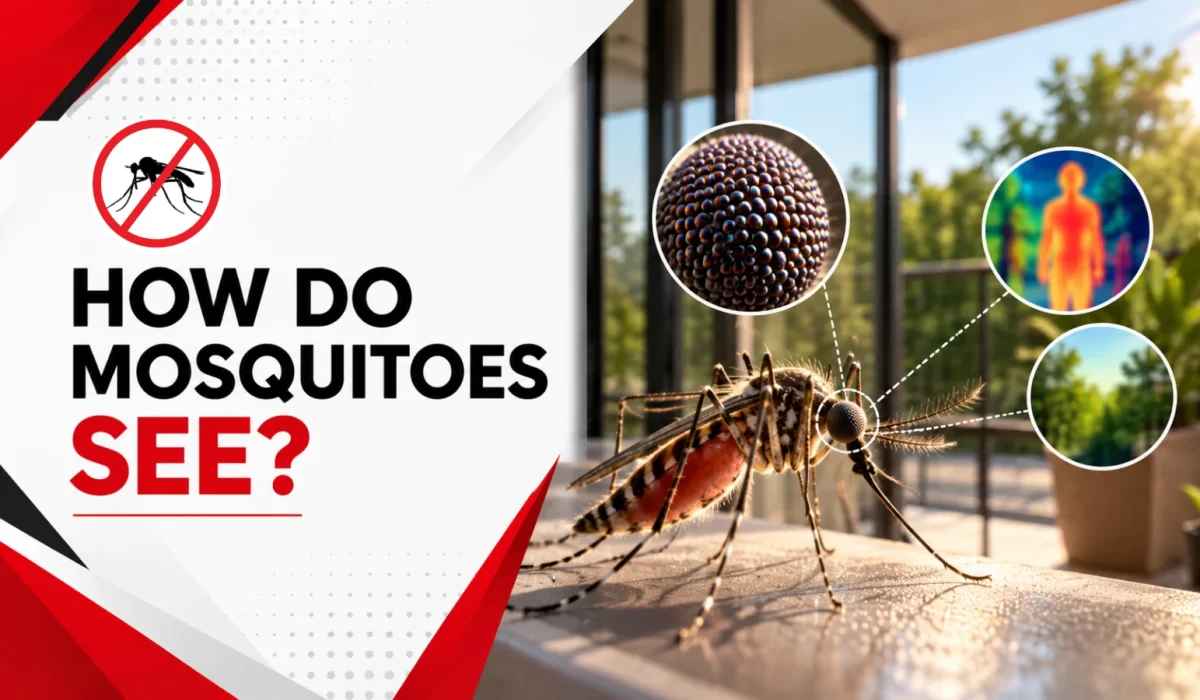
Mosquitoes may be tiny, but their eyes are surprisingly well suited to finding a host. They do not see the world in the same sharp way humans do. Instead, mosquito vision is designed to detect movement, changes in light and certain colours that can help them locate people and animals.
So, how do mosquitoes see humans?
They use several senses together. Their eyes detect visual signals, while their antennae and other sensory organs pick up smells, carbon dioxide and heat. This combination helps mosquitoes find a suitable host, even when visibility is poor.
Understanding mosquito vision can also explain why some colours and surroundings may attract them more than others. Let us look at how mosquito eyes work and what these insects actually see.
How Do Mosquitoes See the World?
Mosquitoes have two large compound eyes on the sides of their head. These eyes are made up of many tiny visual units called ommatidia. Each ommatidium captures a small part of the insect’s surroundings.
Instead of forming one clear image like a human eye, the compound eye combines information from these many units. The result is a broad, mosaic-like view of the surroundings.
Mosquitoes are not known for seeing fine details. Their vision is better suited to detecting changes, movement and contrast. This is useful for a flying insect that needs to avoid obstacles and locate potential hosts.
Their eyes also help them remain aware of what is happening around them while they fly. This broad visual awareness can be useful when searching for a person or animal.
Compound Eyes Give Mosquitoes a Wide View
The compound eyes of mosquitoes contain numerous tiny lenses. Each lens receives light from a particular direction, allowing the insect to gather visual information from a wide area.
This does not mean mosquitoes see a perfect 360-degree picture. However, their eye structure gives them a broad field of view compared with the more focused vision humans use.
Mosquito Vision Is Less Detailed Than Human Vision
A mosquito does not need to recognise your face or read a sign from a distance. Its visual system is mainly useful for detecting movement, contrast and light.
This is why mosquito vision is better described as a system for finding and tracking potential targets rather than seeing a detailed picture of the world.
Do Mosquitoes Use Smell Before Sight?
Yes. Mosquitoes use several senses while searching for a host, and smell plays a major role. One of the most important signals is the carbon dioxide released when people and animals breathe.
When a mosquito detects carbon dioxide, it can become more responsive to other signals that help it find a host. Visual cues can then become more useful as the mosquito gets closer.
This is one reason the question “can mosquitoes see humans?” does not have a simple yes or no answer. Mosquitoes can detect visual features of a person, but they rely on a combination of smell, heat, movement and other cues to complete the search.
Carbon Dioxide Helps Trigger Host Searching
Every time you breathe out, you release carbon dioxide into the surrounding air. Mosquitoes have specialised sensory organs that can detect changes in carbon dioxide levels.
A mosquito may use this information as an early clue that a potential host is nearby. Once it picks up the signal, other senses become important as it continues its approach.
Smell and Sight Work Together
Mosquitoes do not depend on vision alone. Body odours, carbon dioxide, warmth and visual contrast can all provide useful information.
This multi-sensory approach makes mosquito behaviour more effective. A mosquito may first detect chemical signals from a distance and then use visual cues as it gets closer to a potential host.
What Colours Can Mosquitoes See?
One of the most interesting parts of mosquito vision is their response to colour. Research has shown that certain mosquitoes become more attracted to specific colours after detecting carbon dioxide.
These can include red, orange, black and cyan visual signals.
However, colour preference can vary depending on the mosquito species and the conditions around it. It is also important to remember that a mosquito’s colour vision is not the same as human colour vision.
Red and Orange Can Be Attractive
Some mosquito species show increased attraction to red and orange wavelengths after detecting carbon dioxide. Human skin can also create a strong visual signal in this part of the spectrum.
This does not mean that mosquitoes see every person’s skin in the same way. Instead, the visual signal appears to be linked to how mosquito eyes detect particular wavelengths and contrasts.
Dark Colours Can Stand Out
Mosquitoes can also respond to dark objects and strong visual contrast. Black and other dark surfaces may be easier for them to detect against a lighter background.
This is one reason dark clothing is often discussed in relation to mosquito attraction. However, colour is only one part of the process. Smell, carbon dioxide, body heat and movement can also influence mosquito behaviour.
Blue, Green and White May Be Less Attractive in Some Situations
Some studies have found that certain mosquito species show less interest in colours such as blue, green or white under particular conditions.
This should not be treated as a guaranteed way to avoid mosquito bites. A mosquito that detects carbon dioxide, body odour or heat may still approach a person wearing lighter colours.
Can Mosquitoes See in the Dark?
Mosquitoes can be active in low-light conditions, but that does not mean they have excellent night vision. Their ability to navigate depends on available light as well as other senses.
Many mosquito species are active during specific parts of the day. Some are more active around dawn and dusk, while others can bite during the daytime or at night.
In low light, mosquitoes can rely more heavily on chemical and heat-related signals. Their ability to detect carbon dioxide and body odours is especially useful when visual information is limited.
Mosquitoes Detect Movement
Movement can help mosquitoes identify potential hosts. A moving person may create a noticeable visual contrast against the surrounding environment.
Their compound eyes are well suited to detecting changes in their surroundings.
However, they do not need to see a detailed image to respond to movement. This is also useful for avoiding obstacles while flying and adjusting their flight path.
How Do Mosquitoes Find Human Skin?
Finding a person is only the first part of a mosquito’s search. Once the insect gets closer, several additional signals can guide it towards exposed skin.
Body heat, moisture, odours and carbon dioxide can all contribute to the process. The mosquito uses these signals together rather than depending on one sense alone.
This explains why simply changing the colour of your clothing may not be enough to prevent mosquito bites. A mosquito can still detect other cues that point towards a nearby host.
Heat Becomes More Important at Close Range
As a mosquito approaches a potential host, warmth can become an important signal. Human skin is warmer than the surrounding environment, creating a useful cue for a mosquito searching at close range.
Body heat can help the insect identify where to land. Other signals, including moisture and skin odours, may also contribute to this final stage.
Sweat and Body Odour Can Guide Mosquitoes
Human skin releases a range of chemicals through sweat and natural body odour. Mosquitoes have sensory receptors that can detect some of these compounds.
The combination of odour, carbon dioxide, heat and visual contrast creates a stronger signal than any single cue alone.
Do Mosquitoes See People As We See Them?
No. The way mosquitoes see is very different from human vision.
Humans depend heavily on detailed images, sharp focus and colour perception. Mosquitoes have a different visual system that is better suited to detecting movement, contrast and useful wavelengths of light.
A mosquito does not need to see your face clearly to find you. It simply needs enough information to recognise that a potential host is nearby and then use its other senses to locate a suitable place to land.
Final Thoughts
So, what do mosquitoes see? They see the world through compound eyes made up of many tiny visual units. Their vision is not as sharp as human eyesight, but it is well adapted to detecting movement, contrast and particular wavelengths of light.
Mosquitoes can respond to colours such as red, orange, black and cyan, especially after detecting carbon dioxide. As they move closer, other signals such as body heat, sweat and skin odour become increasingly important.
In simple terms, mosquitoes do not rely on their eyes alone. They use sight, smell, carbon dioxide and heat together to find a host. Understanding this unusual sensory system helps explain why these tiny insects can locate people so effectively, even when we can barely notice them.

Sivashankar Maruthachalam
Sivashankar Maruthachalam is the Founder of RK Ecran Private Limited, a Coimbatore-based manufacturer of premium mosquito net doors and windows. Since establishing the company in 2006, he has led RK Ecran from a pioneering startup to a market leader across southern India - with operations spanning Tamil Nadu, Kerala, and Karnataka.. Under his vision and leadership, RK Ecran introduced magnetic swing mosquito doors to the Indian market at a time when cumbersome Velcro-based nets were the only available alternative - a move that redefined the category. Today, the brand has served over 1,00,000 Indian homes, operates a 30,000 sq. ft. state-of-the-art manufacturing facility, and employs a team of 110 - making RK Ecran the first mosquito net brand in India to receive CE Certification from the European Union. Sivashankar's commitment to consistent quality, research-driven innovation, and customer satisfaction has shaped every aspect of the company — from its ISO-compliant manufacturing processes to its growing dealer network across the country.
