
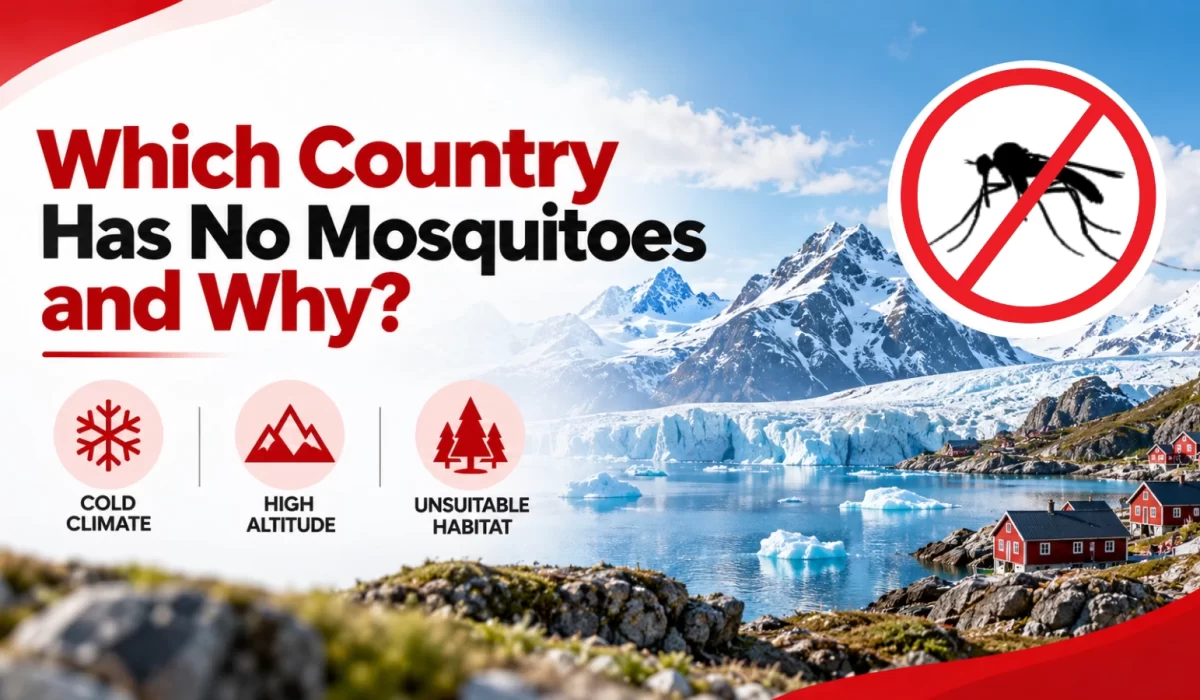
Mosquitoes are found in almost every part of the world. They thrive in warm, humid areas and can adapt to many different environments. Yet, for decades, one country has been famous for having no established mosquito population: Iceland. Iceland’s cold climate, unstable weather and geographical isolation have often been linked to its unusual lack of mosquitoes.
However, there is an important recent update. In 2025, mosquitoes were found outdoors in Iceland for the first time, challenging the country’s long-standing reputation as a mosquito-free nation. Experts have suggested that the insects may now have better chances of surviving and establishing themselves as conditions change.
So, which country has no mosquitoes? Iceland remains the country most famously associated with the absence of an established mosquito population, but it is no longer accurate to describe Iceland as completely mosquito-free.
Understanding why mosquitoes struggled to settle there in the first place makes this story even more interesting.
Why Did Iceland Have No Established Mosquito Population?
Unlike many countries, Iceland has environmental conditions that make it difficult for mosquitoes to complete their full life cycle. The issue is not simply that Iceland is cold. Other cold regions, including parts of Greenland and Scandinavia, have mosquito populations.
The difference lies mainly in how Iceland’s weather changes throughout the year.
Freeze-Thaw Cycles
Mosquitoes need suitable conditions to develop from eggs into larvae, pupae and adults. In many colder regions, mosquito eggs can remain dormant through winter and hatch when spring arrives.
Iceland’s weather can be less predictable. Temperatures may rise and fall sharply, causing repeated cycles of freezing and thawing. These sudden changes can interfere with mosquito development, particularly when mosquito larvae are growing in water.
Incomplete Development
Standing water is important for mosquitoes because their early life stages develop in water. A mosquito may lay eggs in a suitable water source, but the larvae still need enough time and stable conditions to mature.
In Iceland, changing temperatures can interrupt this process. If the water freezes or environmental conditions change before the larvae develop fully, the mosquito may not complete its life cycle.
This helps explain why mosquitoes found it difficult to establish a stable population in Iceland for so long.
Geographical Isolation
Iceland is an island in the North Atlantic Ocean, far from large continental landmasses. This geographical isolation also makes natural migration more difficult.
Mosquitoes can travel with wind, animals and human transportation. Individual mosquitoes have occasionally reached Iceland, including through aircraft. However, arriving in a country is very different from establishing a breeding population.
For a species to become established, it needs suitable breeding sites, food sources and environmental conditions that allow several generations to survive.
Is Iceland Really Mosquito-Free?
This is where the popular claim needs some clarification.
For many years, Iceland was described as one of the few places without an established mosquito population. Individual mosquitoes could still arrive accidentally, but they did not form a lasting population.
That changed in 2025. Scientists confirmed mosquitoes outdoors in Iceland, with further sightings reported after a period of cold weather. Iceland Review reported that an entomologist believed the insects may have become established in the country.
This means the traditional answer to “which country has no mosquitoes?” needs to be updated.
Iceland is a country historically known for having no established mosquitoes, but it should not now be described as completely mosquito-free.
Why Can Mosquitoes Live in Cold Countries?
It may seem surprising that mosquitoes can survive in cold regions. After all, mosquitoes are often associated with hot and humid weather.
However, not every mosquito species has the same environmental requirements. Some species have adaptations that help them survive cold periods.
Mosquito Eggs Can Survive Winter
Certain mosquito species can survive unfavourable conditions by remaining in an inactive stage. Eggs may stay dormant until temperatures and moisture become suitable for development.
Once conditions improve, the eggs can hatch and begin the next stage of the mosquito life cycle. This is one reason why a cold winter does not necessarily eliminate mosquitoes from a region.
What Role Does Iceland’s Weather Play?
Iceland’s climate is strongly influenced by its location in the North Atlantic. The country experiences cool temperatures, strong winds, and rapidly changing weather.
For mosquitoes, these conditions can create several challenges.
Mosquitoes need periods of suitable temperatures to feed, reproduce and develop. A short period of warmth may not be enough if colder weather arrives before the next generation matures.
The traditional explanation from Icelandic biology experts has particularly focused on the country’s unstable spring weather. Unlike regions where winter gradually gives way to a stable spring, Iceland can experience repeated freezing and thawing.
Does Iceland Have Other Biting Insects?
Yes. The absence of established mosquitoes did not mean Iceland was completely free from biting insects.
Biting midges, sometimes called no-see-ums, are present in Iceland.
These tiny flies can feed on the blood of mammals and may become a nuisance during warmer periods. Researchers at the University of Iceland have also studied their spread and establishment in the country.
Black flies and other insects are also found in Iceland. Therefore, saying that Iceland had “no mosquitoes” should not be confused with saying that it had no biting insects.
Could Mosquitoes Become Established in Iceland?
The recent discoveries have made this question more important.
Scientists have noted that Iceland’s insect population has been changing. The University of Iceland has reported that many new insect species have entered the country’s fauna in recent decades.
Researchers have also linked easier establishment of some species with a warming climate and increased international travel.
Warmer Conditions May Create New Opportunities
Mosquitoes need suitable temperatures to reproduce and complete their life cycle. Longer periods of warmer weather could give some species more time to develop.
If warmer conditions become more consistent, the environmental barrier that previously limited mosquito establishment may become weaker.
International Travel Can Move Insects
Geographical isolation does not make Iceland completely inaccessible to mosquitoes. Insects can be transported accidentally through aircraft, vehicles, cargo and other forms of travel.
The bigger challenge for a mosquito is not reaching Iceland. It is surviving there long enough to reproduce and establish a population.
Why Are Mosquitoes More Common in Other Countries?
In many countries, mosquitoes have access to exactly the conditions they need: warm temperatures, standing water and suitable shelter.
Tropical and subtropical areas can provide favourable conditions for mosquito breeding throughout much of the year. Even in cooler countries, mosquitoes can take advantage of warmer summers and temporary pools of water.
Gardens, drains, buckets, plant trays, discarded containers and other areas that collect water can become breeding sites. This is why mosquito prevention is important even in places where temperatures are not particularly high.
How Do Mosquitoes Complete Their Life Cycle?
Understanding the mosquito life cycle explains why water and weather are so important.
- Eggs: Female mosquitoes lay eggs in or near water, depending on the species. Some eggs can remain dormant until conditions become suitable.
- Larvae: Mosquito larvae live in water and feed on small organic particles and microorganisms. They regularly come to the surface to breathe.
- Pupae: The pupal stage is a transition period. The mosquito does not feed during this stage but continues developing towards adulthood.
- Adult Mosquitoes: Once development is complete, the adult mosquito emerges from the water. Female mosquitoes of many species require a blood meal to produce eggs, while both males and females feed on plant nectar and other sources. This complete life cycle requires suitable environmental conditions. Disrupting breeding sites can therefore help reduce mosquito numbers.
Does a Country Without Mosquitoes Mean No Mosquito Protection Is Needed?
Not necessarily.
Mosquito populations can change when environmental conditions change. Increased travel, changing temperatures and the movement of insects between regions can introduce species into places where they were previously uncommon.
For homes in mosquito-prone areas, prevention remains important.
Keeping doors and windows protected with suitable mosquito nets can reduce the chances of mosquitoes entering living spaces. Removing standing water around the home also helps reduce potential breeding sites.
Final Thoughts
For years, Iceland was one of the world’s most unusual examples of a country without an established mosquito population. Its unstable weather, freeze-thaw cycles, limited breeding conditions and geographical isolation created a difficult environment for mosquitoes.
However, the story is changing. Mosquitoes were found outdoors in Iceland in 2025, meaning the country’s famous mosquito-free status now needs to be viewed in historical context.
The lesson is simple: mosquito populations depend on more than temperature alone. Water, weather, breeding conditions, species adaptation and environmental changes all influence where mosquitoes can survive. Even places that once seemed naturally protected can experience changes over time.

Sivashankar Maruthachalam
Sivashankar Maruthachalam is the Founder of RK Ecran Private Limited, a Coimbatore-based manufacturer of premium mosquito net doors and windows. Since establishing the company in 2006, he has led RK Ecran from a pioneering startup to a market leader across southern India - with operations spanning Tamil Nadu, Kerala, and Karnataka.. Under his vision and leadership, RK Ecran introduced magnetic swing mosquito doors to the Indian market at a time when cumbersome Velcro-based nets were the only available alternative - a move that redefined the category. Today, the brand has served over 1,00,000 Indian homes, operates a 30,000 sq. ft. state-of-the-art manufacturing facility, and employs a team of 110 - making RK Ecran the first mosquito net brand in India to receive CE Certification from the European Union. Sivashankar's commitment to consistent quality, research-driven innovation, and customer satisfaction has shaped every aspect of the company — from its ISO-compliant manufacturing processes to its growing dealer network across the country.
